


“The art daddy,” one of my new favorite anonymous art-world muckrakers and meme-making savants, recently typed up a roundup for Observer that apparently raised the hackles of many a scribbler and editor when she only name-checked two outlets — The Art Newspaper and Hyperallergic — as offering something close to “independent art journalism” today. It was a toss-away line in an otherwise reasonable accounting of how art critics are some of the unlucky argonauts who are being thrown overboard as their colleagues and captains rebuild the ship of media mid-sail. Personally, the line was a head-scratcher, but apparently it irked all ten denizens of the art world who read and have time to write emails such that the editors at Observer felt it necessary to post their own reply.
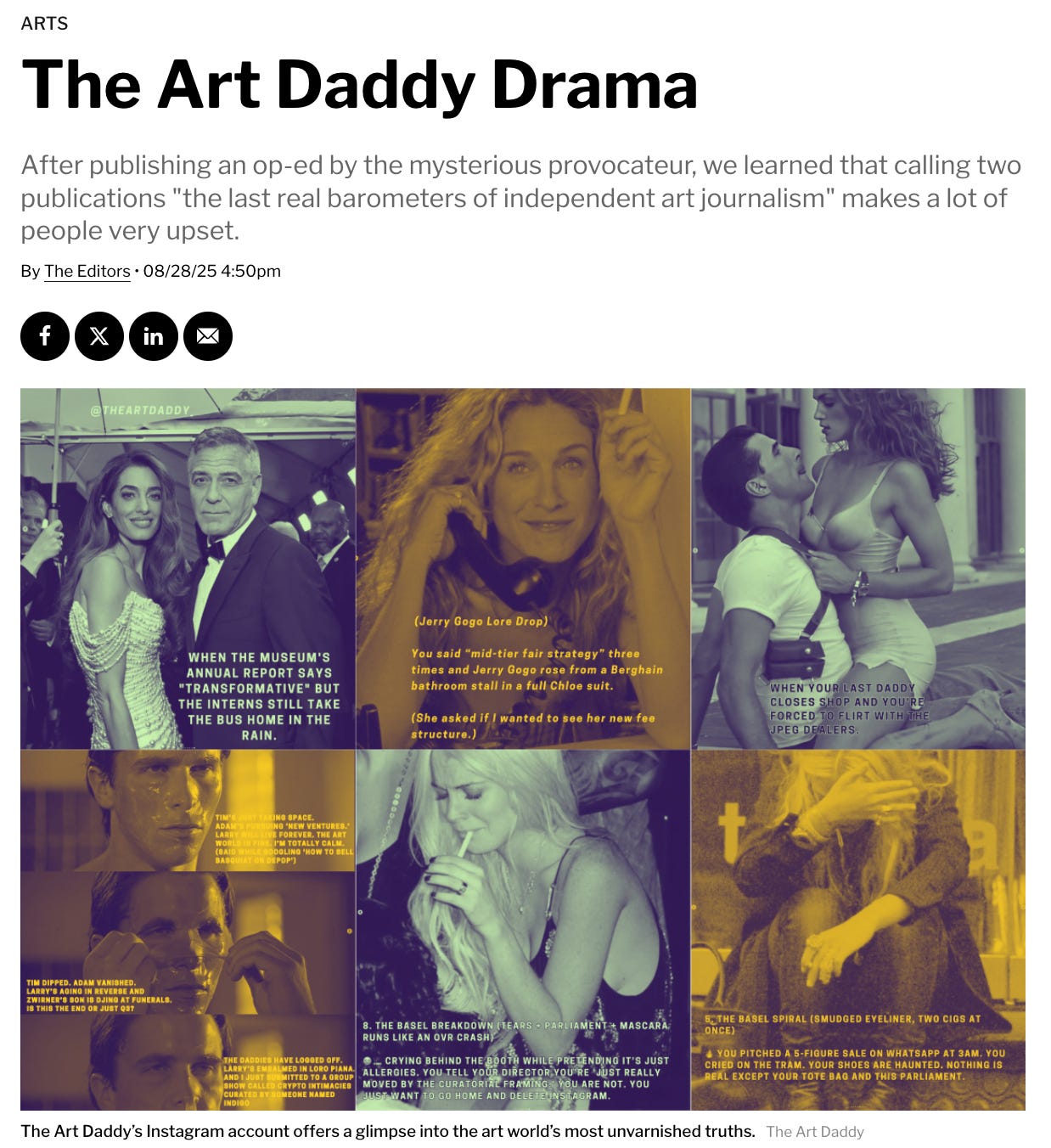
Odd that it would be such a sensitive subject, given how The Art Daddy’s was not the only such take. The last year has seen many hands wrung and pearls clutched over the demise of art criticism: Anna Mikaela Ekstrand wrote something similar to TAD’s account for Whitehot almost a year ago, noting that “PR-ism” has overtaken the column inches that readers (what are those again?) look to for critical judgment in the art, fashion, and lifestyle magazines. Last summer Julia Halperin brought together three NY critics, Siddhartha Mitter, Johanna Fateman, and Emily Colucci, to kvetch about the crisis of criticism in that echt-lifestyle pay-to-play magazine of the moment, CULTURED (which, one should note, Fateman subsequently joined as in-house critic). Fateman was on hand this spring with Brian Dillon, Alex Kitnick, and Ciarán Finlayson to “perform” new manifestos for criticism’s renewal at NYC’s KGB bar, still the city’s most unbearably hip downtown venue, and hosted by 4Columns, the most patronizing of progressive writerly websites (which — crisis!? — will be closing next year after its private-foundation funding runs out). We also have Pierre d’Alancaisez in The Critic dismissing most art critics as “lackeys” for whatever tastes du jour sell ad copy or gratify the collector class (d’Alancaisez trashes Hyperallergic too). We even have a documentary, “Out of the Picture,” from a now former newspaper art critic about five other art critics contending with the “crisis” of their field.
And as if all this weren’t enough, just outside the art world, we have film-critic and beard-connoisseur Richard Brody defending the review form in the pages of The New Yorker in order to stick it to The New York Times, which had just announced its reassignment of various of its culture writers (none of them of the visual-art variety, unfortunately), hinting that the Gray Lady’s arts coverage might be more audiovisual going forward. As if heeding the Times’s call, over at BBC, The Guardian’s theater critic Arifa Akbar hosts a two-part video series that wonders whether the “art of criticism is in crisis.” There is also Kevin Lozano in The Nation, taking the publication of an essay collection — of criticism! — by once-in-a-generation-talent and Pulitzer-winner Andrea Long Chu to opine on — guess what? — the “crisis of criticism,” which Chu addresses directly in one of the previously unpublished essays from her collection (on which more in a moment). And Elvia Wilk, writing on her Substack, has one of the better roundups of all the rudiments of whatever this “crisis” might actually be in writerly precincts; I’m sure there are other less adept assessments, but if there are I haven’t read them (and don’t want to).1
Or course, there is the occasional counter-narrative. Hakim Bishara basically called bullshit on this chicken-littling last May (and this in Hyperallergic — maybe TAD was right?). With more solemnity in ArtReview just last week, Jenny Wu channeled Rahm Emmanuel’s cynically sage advice to “never let a crisis go to waste” by noting that critics, “having turned away from ‘unsalvageable’ institutions and mores,” are now “radically free.”2
Perhaps. I’d like to add to this counter-narrative, but not in the same register. It would seem enough to dismiss the crisis talk by simply pointing to a whole raft of writers and critics active today, such as Janelle Zara, Victoria Comstock-Kershaw (a.k.a. rothko's girlfriend), Allison Hewitt Ward, Alice Gribbin, and Candice T. Seymour, alongside the aforementioned TAD, who publish witty, intelligent, curious, and searching work on Substack as well as in a host of other print and online magazines and journals. Sean Tatol’s The Manhattan Art Review, and its west-coast nemesis Diva Corp, are now practically institutions in their own right and demonstrate what entrepreneurial energy and commitment to production almost for its own sake can deliver. Brad Troemel’s very smart and highly entertaining discursive videos, and his turn to highlighting some less-well-known moving-image works on his social-media channels, are entirely welcome contributions in that line of artist-critic-satirists that stretches back to Ad Reinhardt and Daumier.3 Ben Davis is one of the best in whatever the critic’s business actually is these days, doing quantitative analysis alongside reliably sharp takes. Adam Lehrer, who I have written about before, has begun recently to profile other critics (music ones, mostly) whose work he admires and believes achieve a level of artistry on their own. Even in the musty pages of The New York Review of Books one can find, admire, and try to emulate (if that’s your dish; it’s not mine) the haute-couture prose stylings of Jarret Earnest (and this isn’t to throw shade on Ingrid Rowland or Jed Perl, except perhaps to say that they seem to like all things musty).4
I could go on. But answering the “crisis” talk with a confessional listing of all my personal reading compulsions would just risk accusations of exploitation by further belaboring the point. There really is an embarrassment of riches out there at present (my crisis is finding time to read it all). But none of this addresses the politics of the alleged crisis, which is what seems to be driving the conversation (over a cliff, one wants to add).
Because nearly all of the crisis-mongers can be found mashing one fist into their SparkNotes of Das Capital while shaking the other at the market for condemning all but the most winning critics to lives of penury and bouts of soul-crushing PR-ism. To which I always want to respond: “No one owes you a career as a writer or artist, let alone a critic,” knowing full well that this brands me in the eyes of all of the “freedom’s-just-another-word-for-nothing-left-to-lose” progressives (a la Wu) as a neoliberal shill or crypto-conservative (I know I’m not the latter; the former is up for debate). But that’s the thing: In the art world, we’ve spent well more than just the last decade immersed in a critical and academic discourse peppered with more-and-less Left-wing winks and nods, when not totally salted with outright progressive political commitments. And yet today, JD Vance’s “common good” conservatism and Elizabeth Warren’s regulatory progressivism find much to agree on, and the Trump administration is following Bernie Sanders as much as Xi Jinping on the road to full-blown state capitalism if not authoritarian overreach. It’s all too clear that the old Left-Right “spectrums” and “horseshoe” theories offer far less serviceable metaphors for our political rearrangements than — I’m just spitballing here — a “cluster fuck” or “Alabama goat rope” might. In this upheaval, the reactionary move is to continue with all of those coy signals of political belonging, like decrying the crap pay for art criticism or publishers’ seemingly intolerable codes of conduct, as if this were akin to flashing a little leg. Such signaling may still help folks find their fellow travelers if not their bedmates, but such shibboleth mining and community policing are just a superficial politics of nostalgia. It doesn’t make anyone’s take on the art more interesting, trenchant, or worth reading.
Chu appears as guilty of this as anyone, co-signing the “moral clarity” Zhdanovism that finds its exact funhouse reflection in the “moronic inferno” that is the second Trump administration. When she claims that she believes “leftist values like prison abolition or the right to change sex are substantively superior to others,” she signals the right superstructural issues while dampening the noisy political philosophy of freedom that is these “values’” base. I too think that people should be able to change their sex if they so choose. But it’s entirely reasonable to question how such changes — how such freedoms — affect the social architecture in which they are taken to matter. Not to engage in those questions is to make politics just a game of superficial social sorting, the eighth-grade lunch-room kind.
As much as Chu wishes to come off as a banner-carrier for Left politics when writing about “criticism in a crisis”, she is anything but in her actual criticism. Her essays on Rachel Cusk (“Against ‘Women’s Writing’”) or Octavia Butler (“You Must Decide”), to take just two top-of-mind examples, have at their heart an assessment about what freedom is and means in the works of the artists under consideration. Chu’s invaluable contribution is to show us how sometimes freedom is not what it appears to be (as with Cusk), and sometimes freedom is not even what’s desired (as with Butler); but in every case freedom is the question. It is the value that is superior to others. Both Left and Right claim a monopoly on it, but we know neither is holding the controlling stake. The critic’s job, but not the only one, is to call this bluff.
And to resist this blackmail. No critic is above politics, but nor must the critic submit to anyone’s established ideas, more or less sophisticated as they may be (but usually less), of what their politics are or should be. History doesn’t have a “right” side (though I’ll admit to holding on to this illusion for far too long myself). The confusion of issues for values is just the most obvious way that the current blackmail game gets played. Writing that publishers of criticism should pay their critics is an easy way to get snaps from the gallery (who isn’t for more money?), but warning your fellow critics off, for example, “trying to be funny,” as Fateman does in her 4Columns manifesto, is tantamount to throwing a menacing arm around one’s presumptive colleague and whispering, while leaning in close and conspiratorially, “That’s a nice little reputation you’re building there. Would be a shame to see anything happen to it.” As with our contemporary political reality, we should want to be entirely done with such petty gangsterism.
One of Christopher Hitchens’s more memorable late-breaking lessons came packaged in an exquisitely brief one-two punch: “The people who must never have power are the humorless. To impossible certainties of rectitude they ally tedium and uniformity.” These lines open a paragraph at the beginning of Arguably, his last collection, in which Hitchens offers some context about his own attempts over the previous years at “trying to be funny.” Of those he observed, “I like to believe that these small-scale ventures, too, make some contribution to a conversation without limits or proscriptions: the sin qua non [sic] of the sort of society that knows how to keep the solemn and the pious at bay.”
Contribute to a conversation without limits or proscriptions. Don’t confuse issues for values. Resist blackmail. And, whatever you do, absolutely and affirmatively keep the solemn and the pious at bay. I can think of no better descriptions of the critic’s essential duties than these.
Even in the few days I was writing this piece NYMag’s “Intelligencer” column trudged the same ground.
But Wu also tastelessly ventriloquizes the increasingly poplar class-warrior and scholar of PMC bankruptcy, Catherine Liu, by observing that “no matter if one is trying to climb the ranks or get out of the game, as a gangster or an average worker in a capitalist society, the answer is to kill the boss.” I would have thought that Wu would make strange bedfellows with Taylor Lorenz, but the demographic tracks. Capitalist or not, in a literalist society that has cashiered its capacity for metaphorical thinking, that “answer” is despicable. People who leap Left are going to have to learn that the moribund language of “workers” and “bosses” is just as dehumanizing as all of the other worthless identity categories that have served as proxies for politics for so long.
Keeping It Real Art Critics has drawn a similar, though parallel, line: less critical satire and more para-media exploration of the Art21 model of “coverage.” Joshua Citarella deserves mention in this respect too, though I can’t help seeing something archly sinister in his transformation from artist and educator to silky-voiced talking head at the helm of a media enterprise that feeds on, and is thus a creature of, very-online performative politics. I would not be surprised to find Citarella making a move into real-world — i.e. electoral — politics within the next decade; it is its own established genre of performance art now after all.
In the lane of just straight-up working critics not of the specifically “art” variety, Christian Lorentzen and Becca Rothfeld are two of the best and certainly stand shoulder-to-shoulder (if not toe-to-toe) with writers like Chu. None of this is to dismiss all of the good work that really does go on in the pages of the legacy media rags, both trade-related and mainstream. I will note here, however, a general dissatisfaction with The New York Times, where Jason Farago, who appears to wish every night could be one at the museum, holds forth as if to an audience of nipped, tucked, and highly-plucked middle brows, and the culture desk has decided to launch a “spend-10-minutes-staring-at-these-pixels-on-your-phone-challenge,” which must be a bid to get in on the meditation-app game.
Who will whisper the canon when the critic clicks ‘mute’?
Many thanks for the mention! I published an article by TAD a few years ago exalting the sexiness of a prominent London auctioneer, which to this day is one of the first Google results when you look him up. It’s that’s not fixing the crisis of art criticism then who knows what is